
Halal Certification Flow
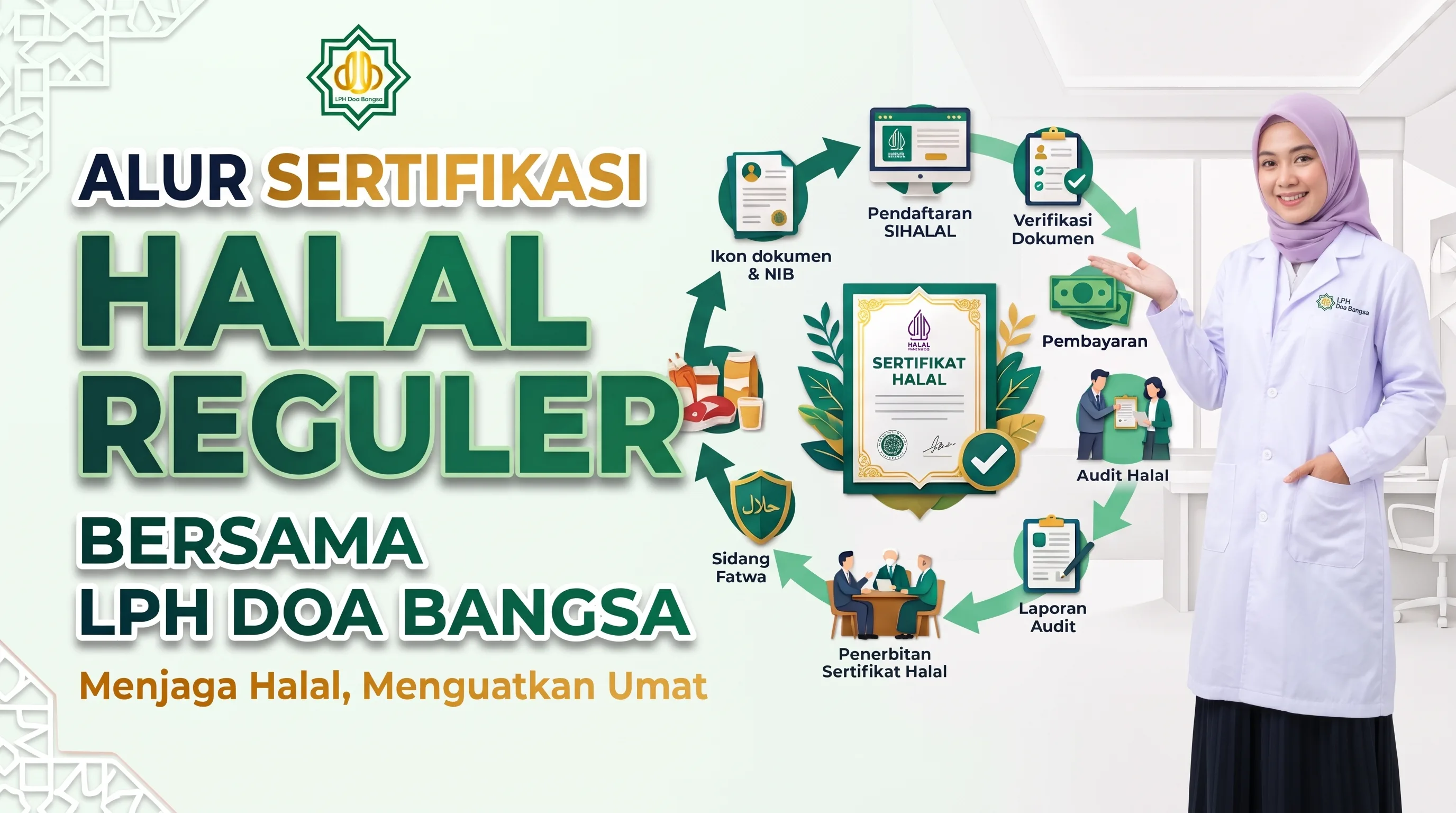
The Regular Halal Certification Process in Indonesia consists of 10 stages involving Business Operators, BPJPH (Halal Product Assurance Organizing Agency), LPH (Halal Inspection Agency), and the MUI Fatwa Commission. Each stage must be carried out in accordance with the applicable Halal Product Assurance regulations. The following explains each stage of the process, including the required documents that Business Operators must prepare before submitting an application.
1. Pre-Registration Preparation
Before submitting a halal certification application, Business Operators must prepare an active email address, a Risk-Based Business Identification Number (NIB), and all required administrative and technical documents.
Regular Halal Certification Requirements
A. Application Letter
The halal certification application letter is automatically generated through the SIHALAL system.
B. Registration Form (For Slaughtering Services Only)
The registration form can be downloaded through the following link:
Requirements for Halal Slaughterers (Juru Sembelih Halal / Juleha):
- Micro and small businesses must have at least one (1) Halal Slaughterer holding a training certificate and/or competency certificate in halal slaughtering.
- Medium-sized businesses, large businesses, and foreign businesses must have at least two (2) Halal Slaughterers holding halal slaughtering training certificates and competency certificates.
C. Legal Documents
- Domestic Business Operators: Risk-Based Business Identification Number (NIB).
- Foreign Business Operators: Business license, importer NIB/official representative NIB, and an official appointment letter for the importer or representative.
- Government Institutions: Decree (SK) establishing the business unit.
D. Halal Supervisor Documents
Business Operators must prepare the following documents for their appointed Halal Supervisor:
- Appointment Decree (SK) for the Halal Supervisor issued by the company management.
- Identification documents:
- A copy of the Indonesian Identity Card (KTP) for Halal Supervisors residing in Indonesia.
- A copy of the passport, permanent residence permit, or other valid identification document for Halal Supervisors from overseas.
- Curriculum Vitae (CV).
- Halal Supervisor training certificate and/or competency certificate, subject to the following requirements:
- Micro and Small Businesses: Halal Supervisor training certificate and/or competency certificate.
- Medium-Sized Businesses, Large Businesses, and Foreign Businesses: Halal Supervisor training certificate and Halal Supervisor competency certificate.
E. Halal Product Assurance System Manual (SJPH Manual)
Business Operators must complete the information regarding ingredients, production process flows, and products. The SJPH Manual document will subsequently be generated automatically through the SIHALAL system.
2. Application Submission through SIHALAL
Business Operators must create an account or log in to the official BPJPH SIHALAL portal and submit a halal certification application. The application requires business information, production facility details, product types and names, ingredient lists, and production process information. All prepared supporting documents must be uploaded to SIHALAL for further processing.
3. BPJPH Administrative Verification
BPJPH reviews the accuracy of the submitted information and the completeness of the halal certification application documents. If any documents are incomplete or do not meet the requirements, Business Operators must make the necessary corrections through the SIHALAL system.
4. Inspection Fee Assessment by LPH
LPH Doa Bangsa calculates and determines the halal inspection fees based on product types, the number of products, production process complexity, and inspection requirements in accordance with applicable regulations. The fee information is communicated to the Business Operator for the next stage of the process.
5. Halal Certification Fee Payment
Business Operators make the required payment according to the invoice issued through the SIHALAL system or the designated payment mechanism. Proof of payment must be submitted in accordance with the applicable procedures for subsequent verification.
6. Payment Verification and STTD Issuance
BPJPH verifies the halal certification fee payment. Once the payment has been confirmed, BPJPH issues the Document Receipt Acknowledgment (Surat Tanda Terima Dokumen / STTD) as the basis for the halal inspection or audit conducted by the Halal Inspection Agency (LPH).
7. Halal Audit or Product Inspection
Halal Auditors from LPH Doa Bangsa conduct halal inspections through document reviews and/or on-site inspections at production facilities. The inspection covers:
- Halal compliance of raw materials, additional ingredients, and processing aids.
- Compliance of halal processing and production procedures.
- Production facilities and equipment.
- Prevention of cross-contamination with non-halal materials or products.
- Implementation of the Halal Product Assurance System (SJPH).
- Compliance of product information and supporting documentation.
If any non-conformities are identified, Business Operators must implement corrective actions based on the inspection findings. The inspection results are subsequently submitted for the halal determination process.
8. MUI Fatwa Commission Session
The product inspection results serve as the basis for the MUI Fatwa Commission to conduct a session and determine the halal status of the products in accordance with applicable regulations. The halal determination is based on the inspection findings and fulfillment of the product's halal requirements.
9. Halal Certificate Issuance by BPJPH
Based on the halal determination, BPJPH issues the Halal Certificate through the SIHALAL system. This certificate serves as official evidence that the product has fulfilled the halal certification requirements in accordance with applicable laws and regulations.
10. Halal Certificate Download
Once the Halal Certificate has been issued, Business Operators can download the digital certificate through their SIHALAL account. The certificate serves as official halal documentation for the product and provides the basis for fulfilling halal labeling requirements in accordance with applicable regulations.
The Role of LPH Doa Bangsa in the Halal Certification Process
LPH Doa Bangsa is responsible for conducting halal inspections and/or testing of products within its accreditation scope granted by BPJPH. Throughout the regular halal certification process, LPH Doa Bangsa is responsible for reviewing application documents, calculating and determining inspection fees, assigning Halal Auditors, and conducting halal audits or product inspections at production facilities.
Through professional, objective, transparent, and trustworthy inspection services, LPH Doa Bangsa supports Business Operators in fulfilling halal requirements until the halal determination is obtained and the Halal Certificate is issued by BPJPH.
```Last updated: 21 November 2026